Skip to the timeline
Schloemann

Forging aircraft parts at 30,000 tonnes

A sourced timeline of the heavy hydraulic forging presses: from Bramah's press to Schloemann's 30,000-tonne press at I.G. Farben's Bitterfeld works, Germany's three 15,000-tonne presses, what became of them after 1945, and the larger presses that followed.

Press ratings are in metric tonnes (t) of force, with US short tons of 2,000 lb where American sources use them. Each entry cites the sources it rests on: open Sources and notes under an entry to read them, with the points on which they disagree.

Before the war

01

Bramah patents the hydraulic press

Joseph Bramah of London patents the hydraulic press in 1795. A small hand pump forces water, a little at a time, into a strong cylinder under a large ram. The force on the ram is the water pressure times the ram's area, so a small effort on the pump gives a very large force on the ram, which moves only slowly.

Blaise Pascal had described the principle more than a century earlier. Bramah's difficulty was keeping the water in: it leaked past the ram until his workman Henry Maudslay fitted a cupped leather collar, which the water itself pressed tight against the ram.

“A vessel full of water is a new principle of mechanics, and a new machine for multiplying forces to any degree one wishes, since a man by this means will be able to lift any load put before him.”

Blaise Pascal, Traité de l'équilibre des liqueurs, written about 1651–1654 and published in 1663 (translated from the French for this exhibit) Read the source
Engraved plate of Bramah's hydrostatic press: the press in elevation with its hand pump beside it, plans of its parts, and sections through the pump and the cylinder with their leather collars.
“Mr Bramah's Hydrostatic Press”: the press with its hand pump, and sections through the pump and the ram's cylinder. Engraving published in London in 1812. Wellcome Collection, CC BY 4.0. Read the source
Sources and notes 6

Bramah's patent (No. 2045 of 1795) was not read. Smiles, Grace's Guide and Stone give 1795; the ASME's landmark page dates Bramah's first industrial press to 1796. Smiles dates Pascal's proposal to 1664, but the treatise was written about 1651–1654 and published in 1663. The plate's date is read from its imprint.

02

Forging presses replace the hammer

In 1861 John Haswell brings a hydraulic press into use for forging hot metal at the Imperial State Railway works in Vienna, and patents it. In Manchester, Joseph Whitworth's works also turn from the steam hammer to the hydraulic press for forging steel.

In 1874 the American engineer W. P. Blake describes the Vienna presses. The larger, with a ram 24 inches (61 cm) across, exerts 1,200 tons; the smaller, with an 18-inch (46 cm) ram, 600 tons. The pumps work at 600 atmospheres.

“the piston is brought slowly down and crowded into the mass as if it were putty or dough”

W. P. Blake on Haswell's presses in Vienna, Transactions of the American Institute of Mining Engineers, 1874 Read the source
Sources and notes 3

Haswell's was not the first press used on hot metal: Stone (1948) names a forging press suggested by John Fox in 1847 and the Dubs press of 1853. Grace's Guide credits the success of Haswell's press with the wide adoption of forging presses. Whitworth's presses are dated only approximately, to about 1861. Blake does not say which ton he means.

03

A 14,000-ton press at Bethlehem

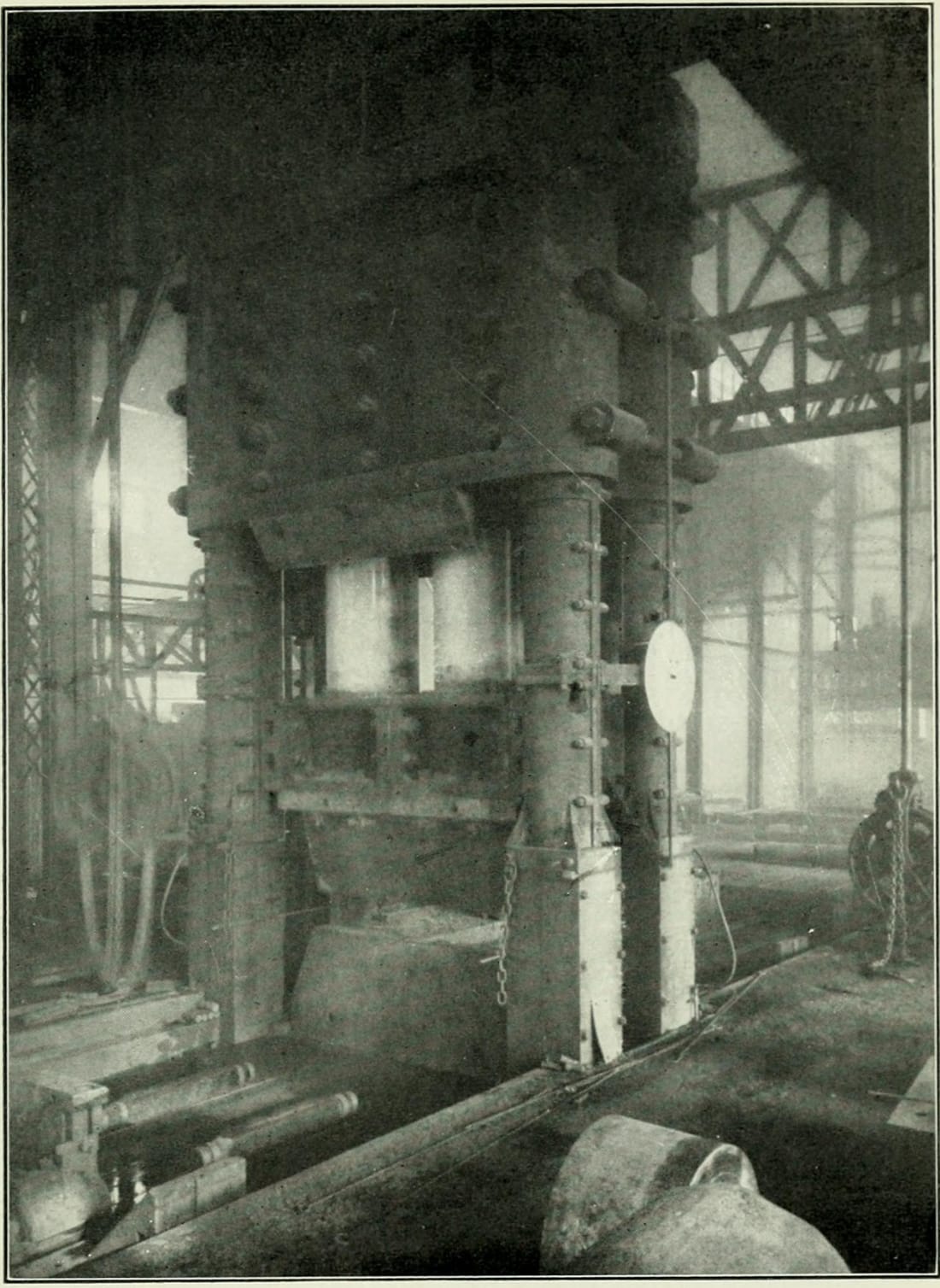
The Bethlehem Iron Company in Pennsylvania completes a 14,000-ton hydraulic forging press in 1893, built under the direction of John Fritz, to forge armour plate and heavy gun parts. It has two cylinders, each about 50 inches (1.27 m) across. The company gives up the 125-ton steam hammer it had built only a few years before.

Presses of this size stay rare. In 1948 an American engineer counted six 14,000-ton forging presses in the world, five in the United States and one in Germany, installed by Krupp about 1930.

A tall hydraulic forging press in a steel-framed shop: heavy columns with large nuts, the crosshead above a block on the anvil, a pressure gauge on one column, and a large round forging on the floor in front.
The Bethlehem press, “Two Cylinders, Each Fifty Inches in Diameter”, as John Fritz published it in 1912. The photograph is undated. From The Autobiography of John Fritz (1912), Fig. 10. Public domain. Read the source

Hammer and press at Bethlehem

Steam hammer
125 tonsThe weight of the falling hammer
Hydraulic press
14,000 tonsThe force the press exerts
The two ratings measure different things, so they are not like for like: a steam hammer is rated by the weight that falls, a press by the force it applies. The sources do not say which ton they use. Read the source
Sources and notes 2

Fritz does not date the press; Stone (1948) gives 1893 and calls the company by its later name, Bethlehem Steel. Fritz gives the cylinders as fifty inches across, Stone as 50½ inches. Krupp's press is known here only from Stone's single sentence.

04

Schloemann of Düsseldorf

Eduard Schloemann, an engineer from Cologne, opens a business selling fittings and steam traps in Düsseldorf in 1885, and in 1901 founds the partnership Eduard Schloemann OHG. About 1908 a fast-acting hydraulic control of the firm's own design, mainly for presses, sells in large numbers.

The engineers Paul Multhaupt, from 1909, and Ludwig Loewy, from 1914, turn the firm to designing complete hydraulic press plants: more than 100 are delivered by 1918. From 1915 Schloemann works with MAN on building presses; it adds rolling mills in 1920 and becomes a joint-stock company, Schloemann AG, in 1921. It remains a design office: other works make the parts of its presses.

Sources and notes 4

Eduard Schloemann lived from 1840 to 1914 (NDB). Aylen gives 1920 for the joint-stock company and the NDB 1921. The Lehigh finding aid records Loewy and Multhaupt as equal owners from 1916; SMS group's history says the firm became part of MAN in the 1920s, while Aylen and the NDB describe MAN as a partner and shareholder.

05

The first giant die-forging press

By 1930 most light-metal die forgings are still made under hammers, and the largest hydraulic die-forging press, in Germany, is rated at 7,000 tons. In 1931 the Soviet Union orders a die-forging press for light metals of 16,500 short tons (15,000 tonnes) from Schloemann. It is built under the direction of Hugo Lorant, then Schloemann's chief hydraulic engineer.

In 1934 the British Air Ministry orders a press of the same size from Schloemann for James Booth Ltd in Birmingham.

Sources and notes 2

The orders are from Stone's paper and the designer from Zeitlin's discussion, both in the ASME symposium of 1953; the British press is not recorded in any other source read. CIA/RR 124 (1958) lists a 15,000-tonne Schloemann forging press delivered to Kramatorsk in 1936; whether it is the light-metal press of 1931 is not established.

06

Ludwig Loewy leaves and Schloemann is Aryanised

Ludwig Loewy, Schloemann's chief engineer and the owner of 45 per cent of its shares, is Jewish. Facing growing discrimination, he leaves Düsseldorf for London early in 1936 with Hugo Lorant and other Schloemann staff, and on 1 April founds the Loewy Engineering Company there. On a brief return to Düsseldorf he is warned that the Gestapo is after him, and returns to London the same day. The Gestapo charges him in his absence with taking the firm's drawings and know-how.

Schloemann's other shareholders are MAN and the Gutehoffnungshütte (GHH) group, which controls MAN. In 1939 GHH obtains an order forcing the transfer of Loewy's shares for a nominal 1,287,593 Reichsmarks, paid into a blocked account. Schloemann is "Aryanised", taken out of Jewish ownership, and passes under GHH's control; its published history is rewritten without him.

“Back in Germany, Loewy's former firm, Schloemann in Düsseldorf, was Aryanised after his departure.”

Jonathan Aylen, historian, 2023 Read the source
Sources and notes 2

The share, the flight and the payment are from Aylen, who draws on the 1947 memorandum; another account gives 8 million Reichsmarks, which Aylen could not confirm. The Lehigh chronology says Erwin Loewy headed Schloemann from 1933 after his brother's departure, which does not fit 1936. Ludwig Loewy died in 1942.

07

A 15,000-tonne press for I.G. Farben at Bitterfeld

I.G. Farbenindustrie's light-metal works at Bitterfeld, in central Germany, melts, extrudes and forges magnesium and aluminium alloys. Late in 1938 a Schloemann die-forging press of 15,000 tonnes (16,500 short tons) goes into service in its North Works.

In a die-forging press the hot metal is squeezed between two shaped dies until it fills them, so the part comes out close to its final shape.

“large drop hammers did not produce satisfactory results, particularly for magnesium, where the forgings that resulted were of poor physical quality”

J. Carlton Ward Jr., on the German presses, Transactions of the ASME, 1953 Read the source
Sources and notes 4

Simpson (1948) gives "late in 1938"; a German engineer debriefed by the CIA gave 1938. The order date, the price and the press's dimensions are not recorded in any source read, and no source names a part it forged at Bitterfeld.

The war

08

A 30,000-tonne press is designed

Late in 1939 I.G. Farben's light-metal department plans a press of twice the force: 30,000 tonnes (33,000 short tons). Its director, Dr. Hubert Altwicker, receives permission to build it in 1940, and I.G. Farben pays for it. Schloemann designs the press, under the engineer Henry Albers, and builds it at Bitterfeld in 1942–43.

The design sets two 15,000-tonne press frames side by side under one pair of long platens. The press has eight columns and eight main cylinders, and stands 16 m (52 ft 6 in) above the floor and about 8 m (26 ft) below it. Every large part is built up from sections.

“No part of the press was to weigh more than 110 tons because of rail transportation problems.”

G. S. Simpson Jr., US Air Materiel Command, Technical Data Digest, 1948 Read the source

Three forces from the same rams

First stage
10,000 tWater at 150 atmospheres
Second stage
20,000 tWater at 300 atmospheres, the accumulators' pressure
Third stage
30,000 tWater at 450 atmospheres, raised by two intensifiers
Forces in metric tonnes and pressures in atmospheres, as Simpson printed them in 1948. The pressures stand in the same ratio as the forces, 1 : 2 : 3: the press changed its force by changing the water pressure on its eight rams. For the first stage the intensifiers worked as pressure reducers. Read the source
Sources and notes 5

The CIOS report of 1945 says the press was projected late in 1939 and took three years to build and install; Simpson gives permission in 1940 and building in 1942–43. Simpson prints the forces as "T"; a check of force against cylinder size shows they are metric tonnes. Zeitlin named Albers as the designer in 1953. Who cast and forged the parts is not recorded: Schloemann had no works of its own.

09

Two more 15,000-tonne presses

Two more Schloemann die-forging presses of 15,000 tonnes are built in Germany, designed under Henry Albers. They do not stand at Bitterfeld. One is at the Hannover-Laatzen works of the Vereinigte Leichtmetall-Werke (VLW); where the other worked is not established.

With the 30,000-tonne press they complete Germany's series of heavy die-forging presses. When the war ends a still larger press is on the drawing board.

Germany's heavy die-forging presses

The first
7,000 t7,700 short tons
Bitterfeld, 1938
15,000 t16,500 short tons
Two more
15,000 t eachOne at Hannover-Laatzen, the other's place unknown
Bitterfeld, 1943
30,000 t33,000 short tons
Designed in 1944
55,000 tNot completed
The series in the order J. Carlton Ward gave in 1953. Ratings in metric tonnes, with US short tons as the exhibit's conversion. Ward printed the large press as "33,000-metric-ton", mixing the two units. Read the source
Sources and notes 6

Ward (1953) gives the order of building but no dates or places. The date label follows Stone (1948), who wrote that the three 15,000-tonne presses went into service "shortly before and during the early part of the recent war" and attributed all three to I.G. Farben. The reports of 1945 and 1955 list only one 15,000-tonne press in the Bitterfeld press shop; modern popular articles that put two there beside the 30,000-tonne press are not followed here. Interavia (1961) does not name the maker of the Laatzen press. The unbuilt press is "55,000-metric-ton" in Ward and "55,000-ton" in the 1983 ASME brochure.

10

The 30,000-tonne press goes into service

By May 1943 the press stands in the new press building of Bitterfeld's North Works, beside the 15,000-tonne press. A German engineer who worked there later dated its first operation to July 1943; Altwicker told the Americans it went into production in 1944. The press is said to have cost 12 million Reichsmarks; Altwicker put the building, the press and its furnaces together at 15 million.

The cast-steel press beds give trouble: Alexander Zeitlin, who later worked with the press's designers, recorded that two beds failed before a third design held.

Black-and-white photograph of a very tall press seen end-on in a high factory hall: two domed tanks and curved pipes on top, a massive crosshead, two rams, a slotted moving crosshead between the columns, a ladder up the left column, and floor planks and rails in front.
The 30,000-tonne press at Bitterfeld on 27 May 1943, seen end-on. The lines across the picture are the joins of the mounted print it was copied from. Chemiepark Bitterfeld-Wolfen GmbH, CC BY-SA 3.0, via Wikimedia Commons. Read the source

“The press shop was equipped with one 30,000 ton press … which is the largest in the world. Its over-all height from base below floor level to top was 86 feet.”

Lt. J. C. Wills, US Naval Reserve, CIOS report XXVI-60, June 1945 Read the source

Forging presses in the new press building

Schloemann, 1943
30,000 tIn service from July 1943 (33,000 short tons)
Schloemann, 1938
15,000 tIn service from late 1938 (16,500 short tons)
Maker not recorded
7,000 tIn the same building in June 1945 (7,700 short tons)
Schloemann, 1940
2,000 tBuilt in 1940 (2,200 short tons)
As listed in the CIOS report of June 1945 and by a German engineer debriefed by the CIA in 1953–55. Both print "ton"; for German press ratings this is the metric tonne. The 7,000-tonne press appears only in the CIOS report; the debriefing also lists smaller presses, hammers and furnaces. Read the source
Sources and notes 5

The start date differs: July 1943 in the CIA debriefing (1955), 1944 in Simpson (1948); the photograph is dated 27 May 1943. The CIOS height of 86 ft (26.2 m) is about 7 ft more than Simpson's drawing gives (52 ft 6 in above the floor and 26 ft 3 in or 26 ft 5 in below); the CIOS figure may include the foundation. The two costs may cover different things. The photograph's caption on Wikimedia Commons says the press was meant for parts of the Ju 288 bomber; no other source read says so.

11

Schloemann's records in the forced-labour archive

The Arolsen Archives, the international archive on Nazi persecution, hold personnel documents of Schloemann AG, Düsseldorf, for employment from 19 August 1943 to 5 March 1945. They are filed in the series on the registration of foreigners and the employment of forced labourers, and came to the archive from Schloemann's successor, SMS Schloemann-Siemag. The catalogue gives no names, numbers or nationalities, and the documents have not been read for this exhibit.

Schloemann's controlling shareholder, the Gutehoffnungshütte group, employed about 31,500 forced labourers at its peak in 1944, nearly a third of its workforce: 22,400 foreign civilian workers, 8,400 prisoners of war and almost 700 concentration-camp prisoners. Whether these figures include Schloemann is not stated. How many forced labourers worked for Schloemann, where they came from and how they were treated is not yet known.

Sources and notes 4

Only the catalogue entry has been read. The GHH figures are from German Wikipedia, citing Bähr and others, Die MAN (2008). Schloemann was a design office; the castings and forgings for its presses were made by other firms, whose workforces are not covered here. The commissioned company history (Schöllgen, 2023) has not been read.

12

Propeller blades, engine mounts and spars

The 30,000-tonne press first forges large parts of gun carriages for heavy artillery, to make the guns lighter. The two big presses are then used mostly for propeller blades in Duralumin, an aluminium alloy, the large press making two at a stroke. The plant's forgings include propeller blades for the Jumo 213, DB 603 and BMW 801 aero-engines, supercharger impellers, cannon frames and engine mounts.

From 1944 the shop develops tapered wing spars forged in one piece. By the end of the war it makes spars 6 metres long in series; spars of 10 metres are not mastered.

“It is noteworthy to mention here that aluminum aircraft propellers were pressed to finished size on the large press eliminating many complicated machinery processes. 80 to 100 propeller blades could be manufactured in eight (8) hours on the 30,000 ton press using two dies.”

CIOS report XXVI-60, June 1945 Read the source
Sources and notes 5

The CIOS reports name engines, not aircraft. Simpson (1948) gives propeller blades, engine mounts and tapered spar caps 19 ft and 33 ft long as the large press's products. German Wikipedia, citing a 1999 local history by H. Fischer that has not been read, says the two presses made 465 different parts for each Ju 88 and spar booms up to 10 metres long for the He 177 and He 219; the CIA debriefing says 10-metre spars could not be made by the end of the war. Which parts came from which press is otherwise not recorded.

13

Forced labour at Bitterfeld

Short of workers, the I.G. Farben works at Bitterfeld and nearby Wolfen use foreign forced labourers, prisoners of war and concentration-camp prisoners. The Arolsen Archives hold the personnel cards and work books of foreigners employed by I.G. Farben at Bitterfeld-Wolfen from 1940 to 1945. Across the whole I.G. Farben concern, its camps held 70,543 foreign civilian workers and 14,156 prisoners of war in February 1943.

On 13 July 1944 the Buchenwald concentration camp tells the SS that 750 women are to be put to work not at Wolfen but at the Bitterfeld works. A subcamp of Buchenwald beside I.G. Farben's film factory at Wolfen held hundreds of women under SS guard. Of the press shop itself, the only statement found is a German engineer's:

“Many German experts were replaced by foreign personnel at the end of the war.”

A German engineer from the Bitterfeld press shop, in a CIA information report of 1955 Read the source

Who these workers were, how many there were and how they were treated in the press shop is not known. Whether the 750 women came to Bitterfeld, and where they worked, is not recorded in the sources read.

Sources and notes 6

The statement on forced labourers, prisoners of war and camp prisoners at Bitterfeld and Wolfen is from German Wikipedia, which gives no numbers. Roth's figures cover the whole concern, not Bitterfeld. Not yet read: the Arolsen cards themselves, the forced-labour card index of I.G. Farben Bitterfeld in the Landesarchiv Sachsen-Anhalt, Dirk Hackenholz's history of the Bitterfeld works (2004), and the collections of the Industrie- und Filmmuseum Wolfen.

14

The end of the war at Bitterfeld

On 16 January 1945 a low-level air raid on the I.G. Farben works at Bitterfeld kills 150 people. Whether the press buildings are hit is not recorded; in June an American report describes the plants as for all practical purposes unbombed. Work on the 30,000-tonne press goes on until the middle of April. On 21 April 1945 American troops reach Bitterfeld and close the works.

Sources and notes 4

The town archive's report on the raid covers the whole works and does not name the press buildings.

After the war

15

Allied teams inspect the presses

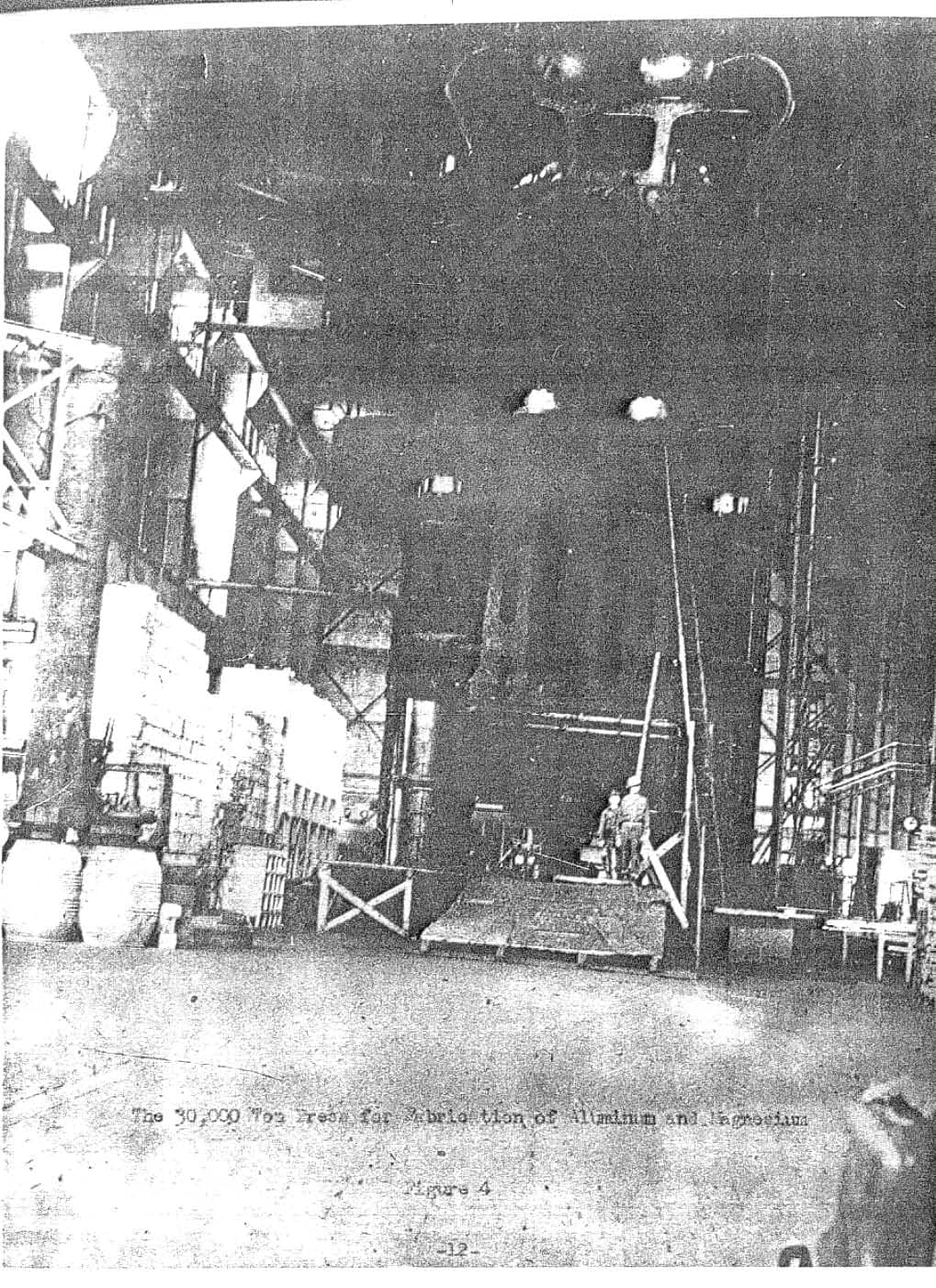
In June 1945 Allied intelligence teams visit the works: Lt. J. C. Wills of the US Navy for the Combined Intelligence Objectives Sub-Committee (CIOS), and a British team from 25 to 28 June. American teams take the blueprints of the 30,000- and 15,000-tonne presses, and US authorities remove the tools and finished forgings. General K. B. Wolfe, later the originator of the US Heavy Press Program, is among the Americans who inspect the German presses.

A US technical mission reaches the 30,000-tonne press with orders to move it west or blow it up. It cannot move the press at short notice and leaves it standing. Bitterfeld lies in the zone agreed for Soviet occupation; at the beginning of July 1945 the Americans withdraw.

Poor photocopy of a photograph of the 30,000-ton press seen end-on in its hall, with two men standing on the press table and a typed caption below.
Figure 4 of the CIOS report, June 1945: “The 30,000 Ton Press for Fabrication of Aluminum and Magnesium”. The two men on the table give the scale. CIOS report XXVI-60 (1945), Fig. 4. Public domain. Read the source

“When the final decision was given, and the territory divided, it was in the Russian zone. We attempted to get the press ourselves before the allocation and the final determination of the zones were made.”

Lt. Gen. K. B. Wolfe, US Air Force, to a Senate subcommittee, 1952 Read the source
Sources and notes 7

The order to move or destroy the press is reported only by Fortune (1951). Ward (1953) wrote that the Russians removed the press and set it up in Russia in August 1945; the CIA debriefing dates the dismantling from March 1946. The date of the American withdrawal is given by German Wikipedia for the neighbouring Wolfen works.

16

An 18,000-ton press for Wyman-Gordon

Large magnesium forgings found in captured German aircraft show that Germany is forging parts larger than Allied methods can make. In 1944 the US War Production Board decides to build a closed-die press of 18,000 short tons (16,300 tonnes), made by the Mesta Machine Co. of Pittsburgh, for a new Wyman-Gordon plant at North Grafton, Massachusetts. The war ends before it is finished, but the work goes on: the plant is completed in 1946, built around the press, then the largest press built in the United States.

A German 7,000-tonne press later joins it as supporting equipment.

Sources and notes 4

The dates differ: Ward (1953) says the press was first installed in 1944, Stone (1953) that it did not get going until 1945, the ASME brochure that the plant was finished in 1946, and Zeitlin (1958) that the press was built in 1947–48. Stone (1948) says the Reconstruction Finance Corporation installed it during the war. Whether the German 7,000-tonne press is the one from Bitterfeld is not known.

17

Dismantled and shipped to the Soviet Union

Bitterfeld is in the Soviet zone, and its presses go to the Soviet Union as reparations. Dismantling of the 15,000-tonne press begins about 20 March 1946, and of the 30,000-tonne press on 28 March. The eight cylinders cannot be drawn out of the top crosshead, so the crosshead travels in sections with two cylinders still in each, about 137 tons a load, on special railway wagons built for transformers, each hauled by its own engine at 10 km/h.

Up to 2,000 men work on the dismantling. From late June to early September 1946 the equipment of both press buildings leaves for the east. The steel frame of the building that housed the 30,000-tonne press is taken down in July and follows it. The work ends in April 1947.

“Twenty-seven trains each with 100 axles were needed to move the equipment to the USSR.”

A German engineer from Bitterfeld, in a CIA information report of 1955 Read the source
Sources and notes 4

Simpson (1948) gives March to May 1946 for the removal. Who the dismantling workers were is not stated. German Wikipedia gives about 70 per cent of the North Works as dismantled in 1946.

18

Two German presses go to the United States

The United States obtains the two other 15,000-tonne presses as reparations, arranged by General Wolfe, with smaller German presses. One comes from the VLW works at Hannover-Laatzen. They are shipped in 1948 and re-erected, one at Alcoa's works in Cleveland, Ohio, the other at an Air Force plant at Adrian, Michigan, run under contract by Bohn Aluminum. By 1953 both are in operation.

What became of them after the 1950s is not recorded in the sources read.

“In 1945 the Air Force, through General K. B. Wolfe, arranged to bring to this country from Germany two 16,500-ton hydraulic closed-impression die-forging presses.”

V. F. Braun, discussion in Transactions of the ASME, 1953 Read the source
Sources and notes 6

Aviation Week (1948) says the presses came from plants in the American zone, but Hannover-Laatzen was in the British zone; which US press came from Laatzen, and where the other stood, is not established. Fortune (December 1951) says the Adrian press had gone into service about six weeks before; Senate testimony of March 1952 says the Cleveland press was working and the Adrian press still being installed. American sources call these presses 16,500-ton, in short tons.

19

Re-erected in the Urals

The Bitterfeld presses are re-erected at Plant No. 268, an aircraft-parts plant at Kamensk-Uralsky in the Urals, inside the steel frame of their old building, enlarged with two new wings. German specialists arrive in July 1949 to help with the assembly. The 15,000-tonne press is assembled from autumn 1949 to spring 1951, and the 30,000-tonne press is ready in 1951; it forges propeller blades again. The new building, for large forgings and extruded sections, opens on 14 September 1951.

The 15,000-tonne press fares badly. A guide plunger breaks within three weeks, then cylinder casings crack, cutting its force to between 5,000 and 7,500 tonnes. The casings had already given trouble at Bitterfeld.

“The erection of the 30,000- and the 15,000-ton forging presses taken from Germany was completed in April-May 1951, and tests began immediately.”

CIA economic intelligence report CIA/RR 124, 1958 Read the source
Sources and notes 4

The CIA debriefing says the 30,000-tonne press was ready in July 1951; CIA/RR 124 gives April–May 1951 for both presses. The plant's own anniversary article (2023) says that vertical presses of 15,000 and 30,000 tonnes and the frame of the new building came from Germany as reparations in the late 1940s; it does not name Bitterfeld or Schloemann. Whether the German specialists went willingly is not stated. A Schloemann extrusion press of 12,000 tonnes from the Dürener Metallwerke at Waren went to the same plant.

20

The US Heavy Press Program

With the 30,000-tonne press in Soviet hands, the US Air Force begins its Heavy Press Program in 1950, with General Wolfe as its originator. By 1957 it has built four forging presses, two of 50,000 short tons (45,400 tonnes) and two of 35,000 short tons (31,800 tonnes), and six extrusion presses of 8,000 to 14,000 short tons.

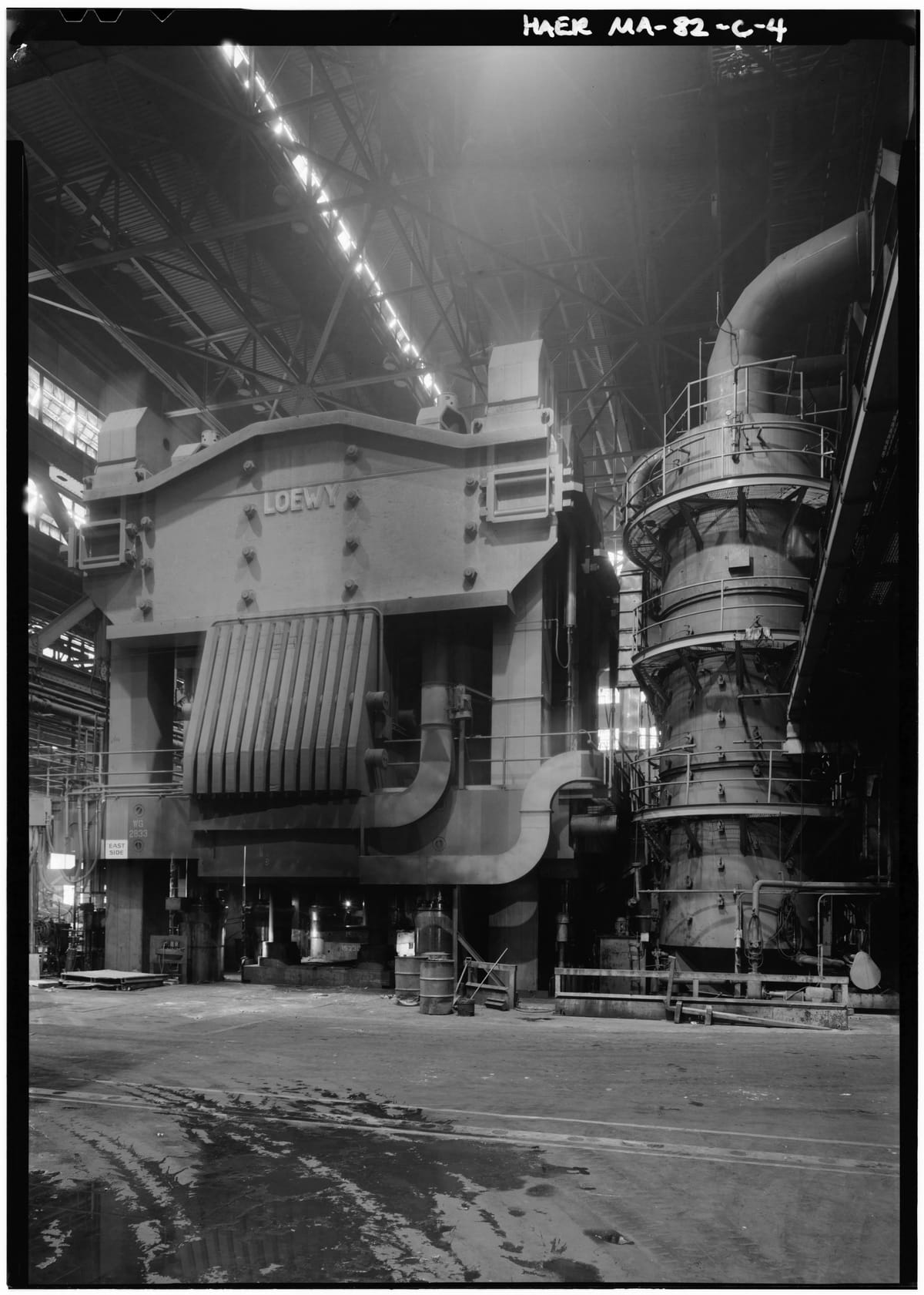
Two of its engineers come from Schloemann. Hugo Lorant, who built Schloemann's first giant die-forging press, is vice-president for engineering of Loewy-Hydropress, and Henry Albers, who designed the wartime German presses, is its chief engineer for the programme. The Loewy Construction Company designs and builds the two forging presses for Wyman-Gordon.

“With the Soviets in possession of so large a press, our Heavy Press Program received added impetus.”

ASME landmark brochure for the Alcoa 50,000-ton press, 1981 Read the source
A massive press in a dark forge hall: a broad steel housing lettered LOEWY above a ribbed guard, with a tall tower of pipes and platforms beside it.
Loewy's 50,000-short-ton press at Wyman-Gordon, North Grafton, photographed in 1985. It began forging in October 1955. Jet Lowe, Historic American Engineering Record, Library of Congress (HAER MA-82-C). Public domain. Read the source
Sources and notes 6

Some accounts date the programme from 1944, when the Grafton press was ordered; the ASME brochure dates its start to 1950. CIA/RR 124 lists the presses built from 1951 to 1957, in short tons. Lorant left Schloemann with Loewy in 1936 (Aylen); when Albers left Germany is not recorded.

21

Forging presses of 50,000 short tons

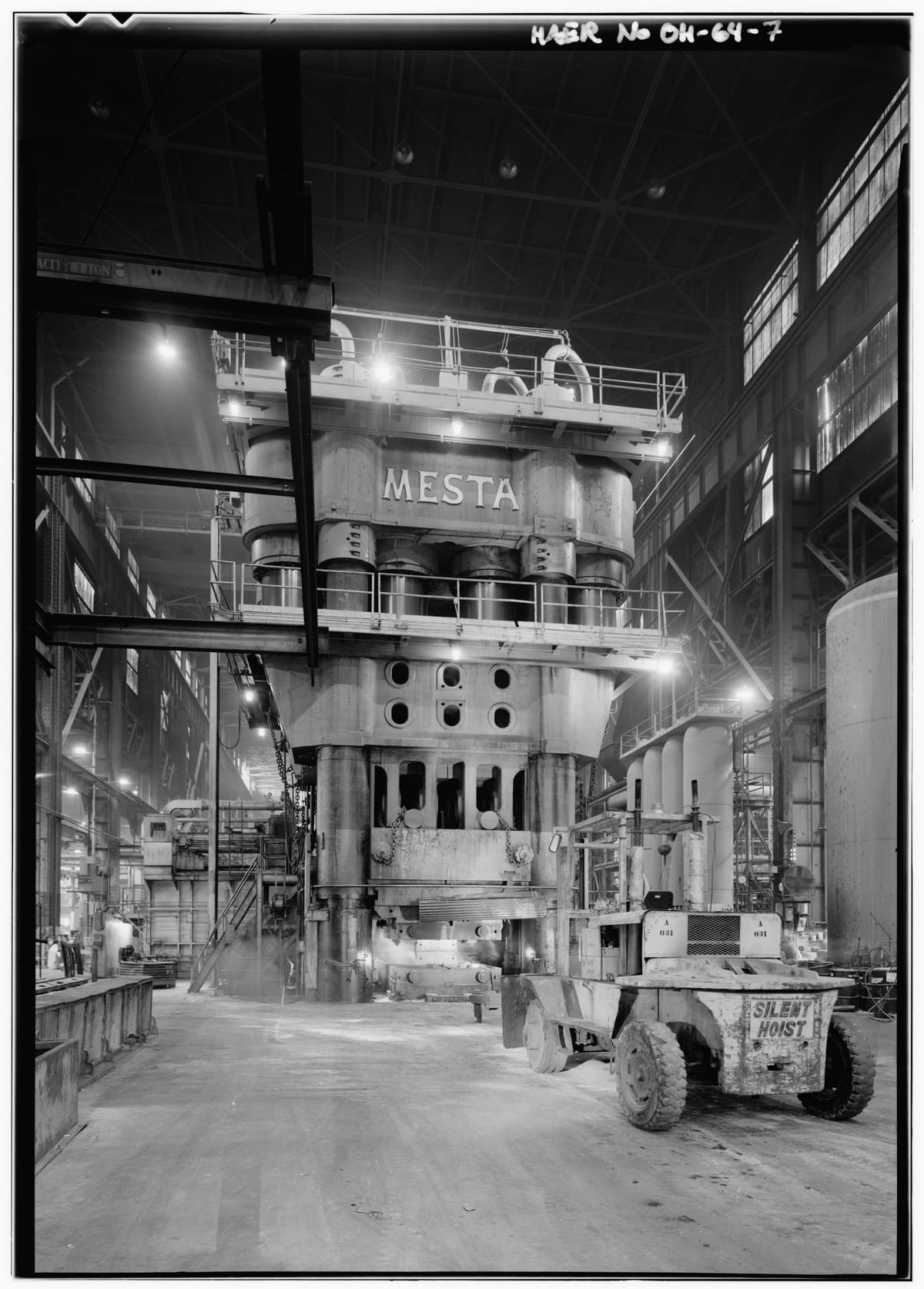
The programme's forging presses start work in 1955. At Wyman-Gordon's North Grafton plant, Loewy's 35,000-short-ton press begins in February and its 50,000-short-ton press in October. At Cleveland, Alcoa runs Air Force Plant 47 from 5 May 1955, with a 50,000-short-ton press by the Mesta Machine Co.; Alcoa and Wyman-Gordon each also receive a press of 35,000 short tons.

The Mesta press stands 26.5 m (87 ft) high, 11 m (36 ft) of it below the floor, and is driven by eight cylinders with water at 310 bar (4,500 psi): much like the Bitterfeld press in height and number of cylinders, with half as much force again.

A tall press in a lit forge hall, its top crosshead lettered MESTA above a row of cylinders and a railed platform, with a forklift truck in the foreground.
The Mesta 50,000-short-ton press at Alcoa, Cleveland, seen from the east in May 1985. Jet Lowe, Historic American Engineering Record, Library of Congress (HAER OH-64). Public domain. Read the source

Bitterfeld and Cleveland

Bitterfeld, 1943
30,000 t33,000 short tons; eight cylinders; 26.2 m (86 ft) from base to top
Cleveland, 1955
45,400 t50,000 short tons; eight cylinders; 26.5 m (87 ft) from base to top
Rated forces in metric tonnes, with US short tons of 2,000 lb: the German press was rated in tonnes, the American in short tons. Heights from the CIOS report (1945) and the Historic American Engineering Record (1988). Read the source
Sources and notes 4

The 50,000-ton figures are short tons, about 45,400 tonnes; the 35,000-ton presses are about 31,800 tonnes. The Mesta press was rebuilt in 1974.

22

Airframe parts forged in one piece

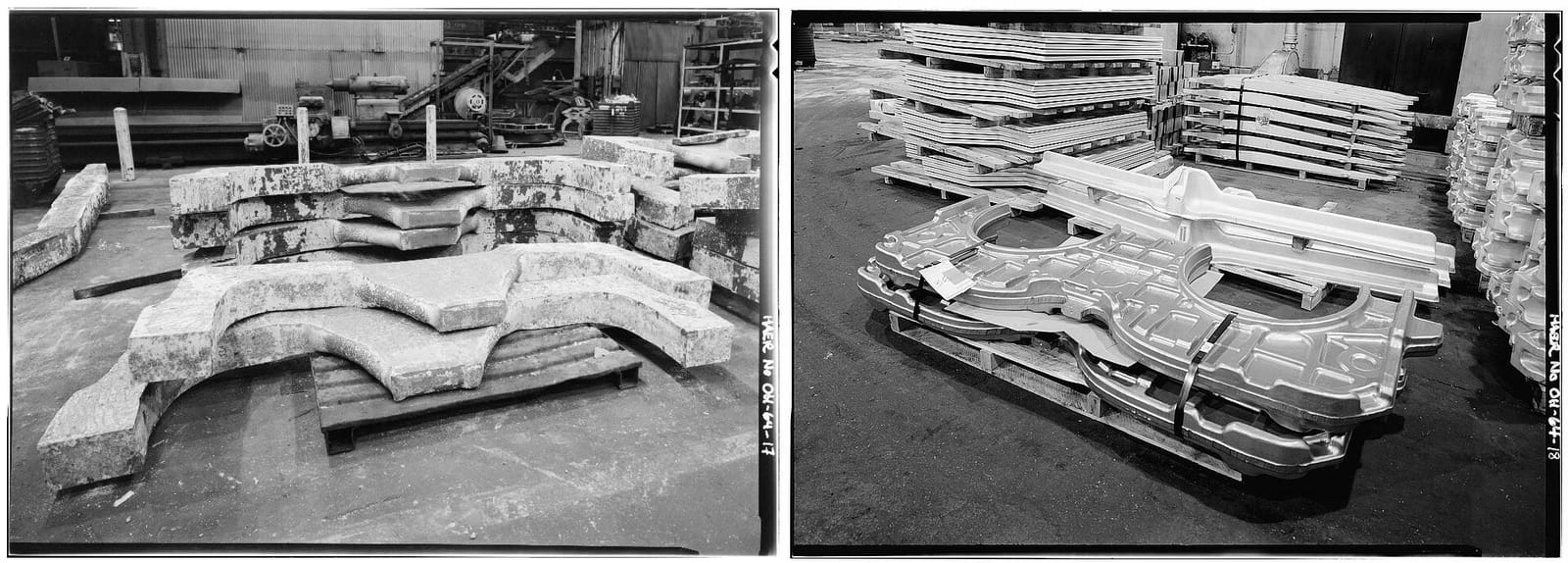
The first part forged on Wyman-Gordon's 50,000-ton press is a landing-gear support rib for a Lockheed Super Constellation; an aluminium wing spar for a Century-series fighter follows in 1956. Magnesium, the metal that started the programme, gives way to aluminium alloys and later to titanium and steels.

For the Boeing 747, Wyman-Gordon forges a main landing-gear beam in titanium, 6 m (20 ft) long and over 1,800 kg (4,000 lb), in place of an assembly of many parts. At Cleveland the Mesta press forges titanium bulkheads for the F-15 fighter.

Two photographs side by side: at left, rough titanium blanks stacked on pallets; at right, finished bulkhead forgings with ribs and openings, stacked on pallets.
Titanium bulkheads for the F-15 before and after pressing on the Mesta press at Cleveland, May 1985. Jet Lowe, Historic American Engineering Record, Library of Congress (HAER OH-64). Public domain. Read the source
Sources and notes 2

The ASME brochure dates the 747 beam to "the early 1960's", before the 747 was designed, so no year is given here.

23

Schloemann becomes part of SMS

After the war Schloemann turns to the continuous casting of steel, working with the Concast company from 1956. In 1973 it merges with Siemag of Siegen to form Schloemann-Siemag AG, with the GHH group holding 51 per cent. The company has traded as SMS group since 2015.

Sources and notes 3

The NDB gives 1998 and SMS group 1999 for the later merger that formed SMS Demag. The company's published histories say nothing about 1933–1945.

24

Larger presses

A 65,000-tonne die-forging press built in the Soviet Union is inaugurated in 1977 at Interforge in Issoire, France, the largest outside the Soviet Union; by 1983 two presses of 75,000 tonnes are working in the Soviet Union itself. China National Erzhong Group's 80,000-tonne press at Deyang, 42 m tall, is ready by 2012. In 2018 SMS group, Schloemann's successor, completes a press of 540 meganewtons (about 55,000 tonnes, or 60,000 short tons) for Weber Metals in California.

Press ratings, 1893 to 2018

Bethlehem, 1893
14,000 tonsWhich ton is not stated
Bitterfeld, 1943
30,000 t33,000 short tons
Cleveland and Grafton, 1955
45,400 t50,000 short tons
Issoire, 1977
65,000 t71,500 short tons
Soviet Union, by 1983
75,000 tTwo presses; 82,500 short tons
Deyang, 2012
80,000 t88,200 short tons
Weber Metals, 2018
55,000 t540 meganewtons; 60,000 short tons
Nominal forces in metric tonnes (t), with US short tons of 2,000 lb; one tonne of force is 9.81 kilonewtons. Conversions not printed in the sources are the exhibit's. The Bethlehem press forged steel in open dies; the others are closed-die presses. Read the source
Sources and notes 7

Other accounts date the Issoire press to 1974–1976 and the Deyang press to 2013. The 1983 report does not say where or when the two Soviet 75,000-tonne presses were built; CIA/RR 124 found no press larger than 30,000 tons under construction in the Soviet Union early in 1958. The Weber Metals date is from trade reports of the press's opening.

25

The Bitterfeld press is modernised

Plant No. 268 is now the Kamensk-Uralsky Metallurgical Works (KUMZ). In April 2010 it signs a contract with Uralmash to modernise its 300-meganewton (about 30,600-tonne) die-forging press made by Schloemann, still the most powerful press at the plant. Uralmash has already made new frame parts and repaired the press's crown; the new hydraulic controls come from Oilgear of the United States. The modernised press is restarted in May 2012.

“The press of the German firm SHLOEMANN has worked at KUMZ for more than 60 years, remaining the most powerful press at the plant.”

Evropeysko-Aziatskie Novosti, Yekaterinburg, 23 April 2010 (translated from the Russian) Read the source
Sources and notes 5

No KUMZ or Uralmash source read names Bitterfeld. The identification rests on the CIA reports, which trace the Bitterfeld 30,000-tonne press to Plant No. 268, and on the 2010 report of a Schloemann press of this size working there for over 60 years. The plant's anniversary article of 2023 dates the start of production on the modernised press to 2013, after the repair of all its base parts and the replacement of its hydraulics and controls. 300 meganewtons is the press's rating in today's units; 30,000 tonnes of force is about 294 meganewtons.